The Hybrid 3D Workflow: Combining Blender and AI for Animation
For decades, 3D animation has had a reputation for being slow and expensive. Creating detailed models, building environments, rigging characters, animating movements, and waiting for heavy render farms to process the lighting can take months of work for a simple sequence. However, in 2026, a new paradigm has emerged: the hybrid 3D workflow. By combining traditional modeling suites like Blender with modern generative AI engines, studios are completing high-end animation cycles in days instead of months.
What is a Hybrid Workflow?
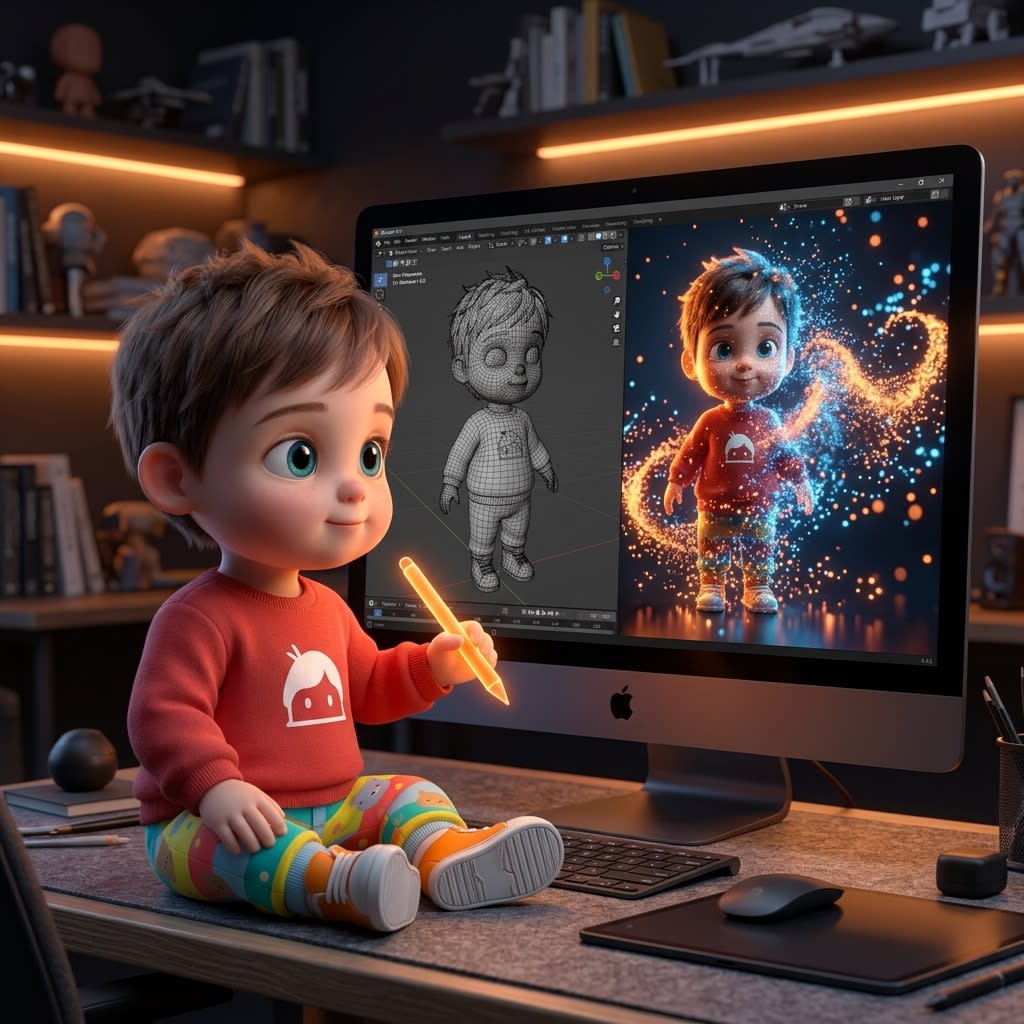
A hybrid workflow does not mean letting AI generate your entire video from text. Text-to-video tools are too unpredictable for complex stories. Instead, a hybrid workflow uses traditional 3D software to build the structure (geometry, motion curves, scene layouts) and uses AI to handle the detailed textures, color grading, lighting, and rendering. You get the absolute spatial control of Blender, combined with the lightning-fast creative speed of AI.
Step 1: Rough Blockout in Blender
The animator starts in Blender by creating a simple 3D layout of the scene. You don't need complex textures, high-polygon counts, or perfect lighting. You use basic shapes (primitives) to place characters, walls, and props, and animate their basic movements. This establishes the camera path, perspectives, and action timing with 100% precision.
Step 2: AI-Powered Texture and Environment Generation
Instead of manually UV-mapping and painting textures for every prop and background wall, artists use AI to generate seamless textures based on descriptive text. Furthermore, background environment plates can be generated as spherical HDR images or 2D backdrops directly by AI, then brought into Blender to serve as world lighting (IBL) and background art, saving dozens of modeling hours.
3. Render Pass to AI Styling (Image-to-Video)
Once the basic animation passes are ready, instead of waiting for cycles or Eevee to render photorealistic lighting over thousands of frames, creators render a rough, low-detail pass. They feed this rough pass into an AI video-to-video pipeline (like Kling or Runway), using prompt descriptors to overlay complex detail—such as cinematic fog, clothing textures, complex light reflections, and stylization. The AI uses the 3D structures as a structural constraint, ensuring perfect motion tracking and spatial consistency.
Why This Matters for Animation Studios
By shifting rendering and detail-pass burdens to AI, small studios can compete directly with large production houses. You bypass expensive render farms and speed up concept validation. Directors can test multiple styling themes (e.g., cyberpunk, watercolor, or photorealism) over the exact same animated layout in real-time, offering clients unprecedented creative choices. The hybrid 3D workflow is the future of media production—leveraging structural logic and machine creativity in perfect harmony.